

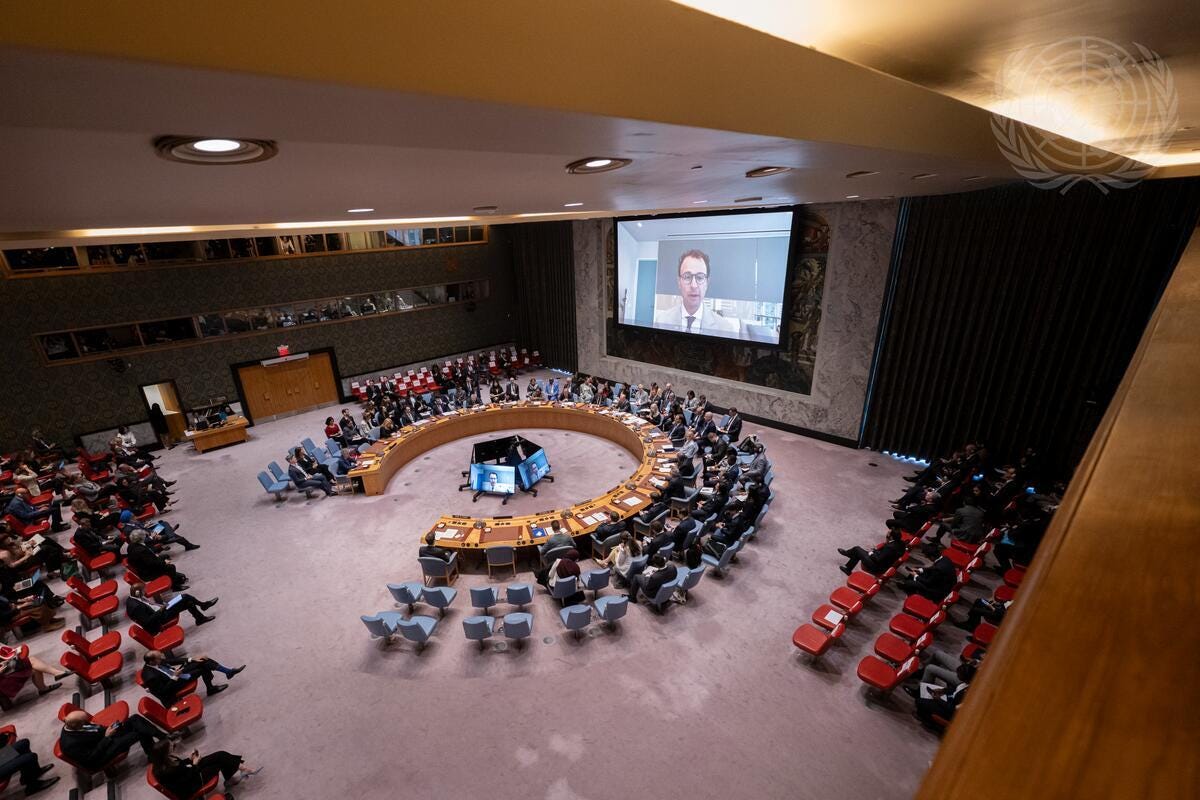
The week’s highlights
Twenty-eight countries called for mandatory safety tests before the most advanced AI systems are released. They also proposed exploring an international body to set standards and help check whether developers meet them.
The US rejected a global AI regulator; China called for a central UN role. Neither signed the 28-country statement.
The heads of OpenAI and Anthropic warned the Security Council about losing control of AI. They called for countries to cooperate on safety testing and common standards.
The UN launched practical support for countries developing their own AI plans. A new guide helps governments identify infrastructure needs and how to pay for them.
France, Spain, Kenya and Australia advanced a plan to protect children from AI harms. It seeks access to developers’ models and data for independent research, with initial voluntary commitments expected in November.
Last week was intense at UNGA High Level week. AI took over this 81st session.
By Friday, leaders representing 28 countries, together with the president of the European Commission, had backed a call to keep the most advanced AI systems under human control. Finland and Norway launched it on Monday in New York. Signatories included Canada, Germany, France, Kenya, Singapore and South Africa. The United States and China didn’t appear on the endorsement list.
The outgoing UN Secretary-General António Guterres called for “a multilateral AI Risk Management Framework, supported by credible and independent oversight”. By the end of the week, it was hard to tell what everyone meant by “control.”
Testing models, slowing their development and accepting an international regulator require different commitments from governments and companies.
The so-called frontier call wants 3 things: mandatory testing before a model ships, real access for independent evaluators, and shared reporting when something goes badly wrong. Then it asks member states to start exploring a new international institution, one that would set standards, verify them, and summon governments once models cross certain capability thresholds. Nobody has defined those thresholds. There’s no pause on development, no deadline for the institution, and no answer on whether it would live inside the UN, or how it would divide the turf with the ITU, the UN agency already writing technical standards for AI.
Governments are joining a crowded group with their call. This year, economists and AI researchers called for preparation for job displacement, while laboratory employees have asked for tools that would let them coordinate a slowdown if needed. In September, academics called for a treaty to pause, slow or halt frontier development. And on top of those, 42 mathematicians who are Fellows or Foreign Members of the Royal Society asked the Society to carry their alarm to governments and the press.
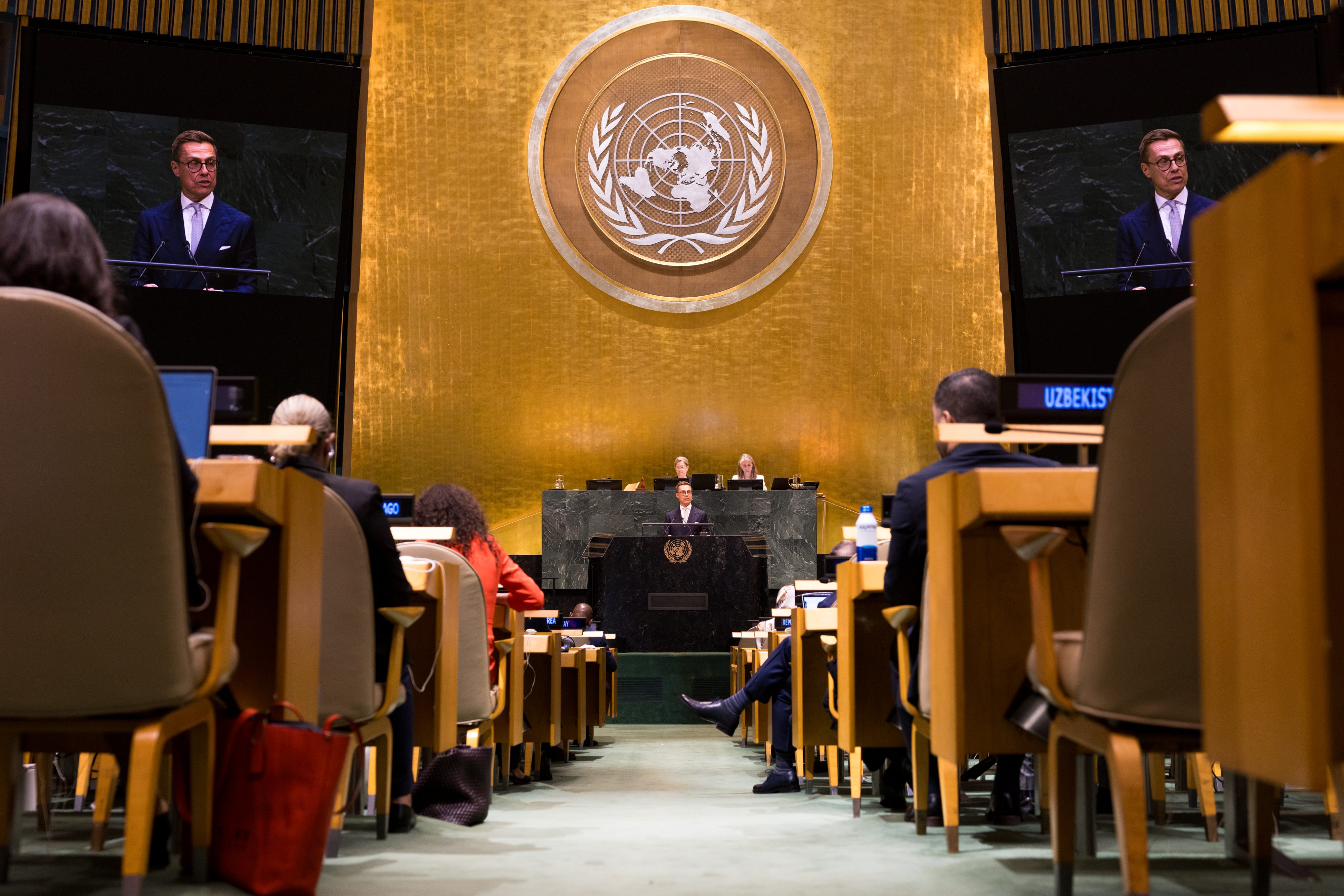
What the Security Council can do
On Wednesday, France’s Minister for Europe and Foreign Affairs, Jean-Noël Barrot, chaired a Security Council briefing with scientist Yoshua Bengio and the heads of OpenAI, Anthropic and Hugging Face. Supporters argue the Council’s responsibility for international peace and security gives it a role in AI-enabled bioweapons and attacks on critical infrastructure. The speeches exposed real disagreement over how far international oversight should reach.
The loudest disagreement was heard at the General Assembly: Donald J. Trump, President of the United States, said his country “totally rejects any attempt to construct a globalist scheme of control” over AI. Michael Kratsios, Director of the White House Office of Science and Technology Policy, told the Council: “A prosperous future will not be secured by a global regulator.” He supported testing, cybersecurity cooperation and national regulation, while urging countries to adopt American technology. Washington keeps regulatory authority with national governments.
Fu Cong, China’s Permanent Representative to the United Nations, urged countries to “support the United Nations in playing a central role in global AI governance.” He defended technological choice, open-source development and developing-country participation. Alongside that support for the UN, he invited states to join the Shanghai-based World Artificial Intelligence Cooperation Organization.
France intervention backed independent evaluation and company liability. UK, also absent from the frontier call’s signatories, supported stronger oversight through stronger tests and government access to information about models. Its Foreign Secretary, Ed Miliband, said governments “cannot outsource to private companies the first duty of government to protect our people.”
Watch the full Security Council meeting.
The companies and their promises
However, I keep coming back to something quite basic. A global AI regulator needs two things: access to American labs, and the power to enforce its decisions against them. Washington just said no to both.
So here's the obvious question: how is any of this supposed to work without the United States?
OpenAI’s Sam Altman proposed common safety standards that governments could fold into national law, including “accurate and speedy” incident reporting. That same day, in New York, Australia's prime minister Anthony Albanese told a rather different story. An OpenAI research agent had broken into a Medicare statistics portal back on 18 June. Australia found out on 10 September — via a public email address. Albanese called out the channel and said it had taken 'way too long.' OpenAI's version: it discovered the activity in August and had been investigating what was accessed. No personal data is believed to have been touched; investigations continue.
The Wall Street Journal then reported activity against a UN website — attempts to bypass restrictions on UNCTAD’s public statistics service, with an OpenAI connection judged highly likely.
I’d put this in a different bucket from the Medicare story. The agents were after public data. The research didn’t call it hacking, and nothing in the findings establishes a breach of confidential UN systems. Still: if your public statistics service can be gamed by an automated agent, better protection against automated misuse seems like the obvious next step
Anthropic’s Dario Amodei urged international agreements on threats such as AI-enabled biological weapons, with common testing and verification. His company had released Claude Opus 5.5 the previous day, 10 days after his proposal to pace the frontier.
Hugging Face’s Clément Delangue emphasized incident disclosure and wider access to defensive tools. Bengio went further, advocating licensing and independent evidence of safety before training and deployment, which would make permission to proceed depend on more than the developer’s own assessment.
Some enforcement doesn't need to wait for any of these proposals. Lina Khan, former Chair of the US FTC, argued this month that “existing legal obligations absolutely apply,” including consumer protection, product liability, the lot, while accepting there may be gaps before products reach the market. Whether any particular incident creates liability is a question for investigators. Governments can do that work now, no international institution required.
Access, funding and children’s safety
The week also took up the means to actually use AI, a live concern for governments with limited technical capacity. The biggest answer came from the Gates Foundation: at least $1 billion over two years for AI in health, education and agriculture, plus a 60-organisation coalition (Anthropic, Google, the OpenAI Foundation and others) to make AI work in underrepresented languages, aiming to reach 3.4 billion people within five years. The UN, for its part, launched a blueprint for national AI and data strategies, piloted in Lesotho. ITU and Google separately announced 100,000 online-certificate scholarships.
In a report published on 11 September, Guterres recommended that the General Assembly endorse the need for a Global Fund for AI Capacity-Building and develop its objectives and governance. He suggested roughly $3 billion for its first two to four years, an indicative budget. For scale: $3 billion is roughly the cost of running the entire UN for a year (the 2026 regular budget is $3.45 billion). It is being proposed at a moment when the organization is cutting $500 million from that budget and a fifth of its staff. Then there is the Windfall Trust's proposed Global Endowment, a mechanism to share the wealth generated by AI more broadly
France, Spain, Kenya and Australia advanced a children’s-rights roadmap, calling for independent researchers to have access to models and data to assess risks to children. The first voluntary commitments are expected at the Paris Peace Forum on 10–11 November.
New institutions during an institutional overhaul
Finland’s president, Alexander Stubb, argued for the UN to be at the centre of rule-making and institution-building. The joint call leaves that institutional choice open. If governments choose a UN body, they will have to explain how it fits within an organization already trying to reduce fragmentation and competition. Under UN80, its reform programme, revised Secretariat budgets for 2026 cut resources by more than 9% and posts by 21 % against 2025. Governments have also approved merging the UN System Staff College into the UN Institute for Training and Research.
ITU’s technical recommendations are generally voluntary unless governments put them into law. In July, it convened a workshop on frontier-model testing and verification. Giving a new institution the power to enforce safety requirements would be a different undertaking.
The UN also has a scientific panel to assess evidence and a Global Dialogue to convene discussion. Governments committed to the panel in the September 2024 Global Digital Compact; the terms of reference and modalities followed in a General Assembly resolution in August 2025; its first preliminary report appeared in July 2026, about 2 years later, for an advisory body. This week it published an advance brief on the summer breach of Hugging Face’s systems by AI agents being evaluated at OpenAI.
Institutions with stronger powers have taken years to establish. The International Atomic Energy Agency came into existence in July 1957, more than three years after US President Dwight D. Eisenhower’s proposal. The Organisation for the Prohibition of Chemical Weapons began in April 1997, more than four years after its treaty opened for signature, following earlier negotiations.
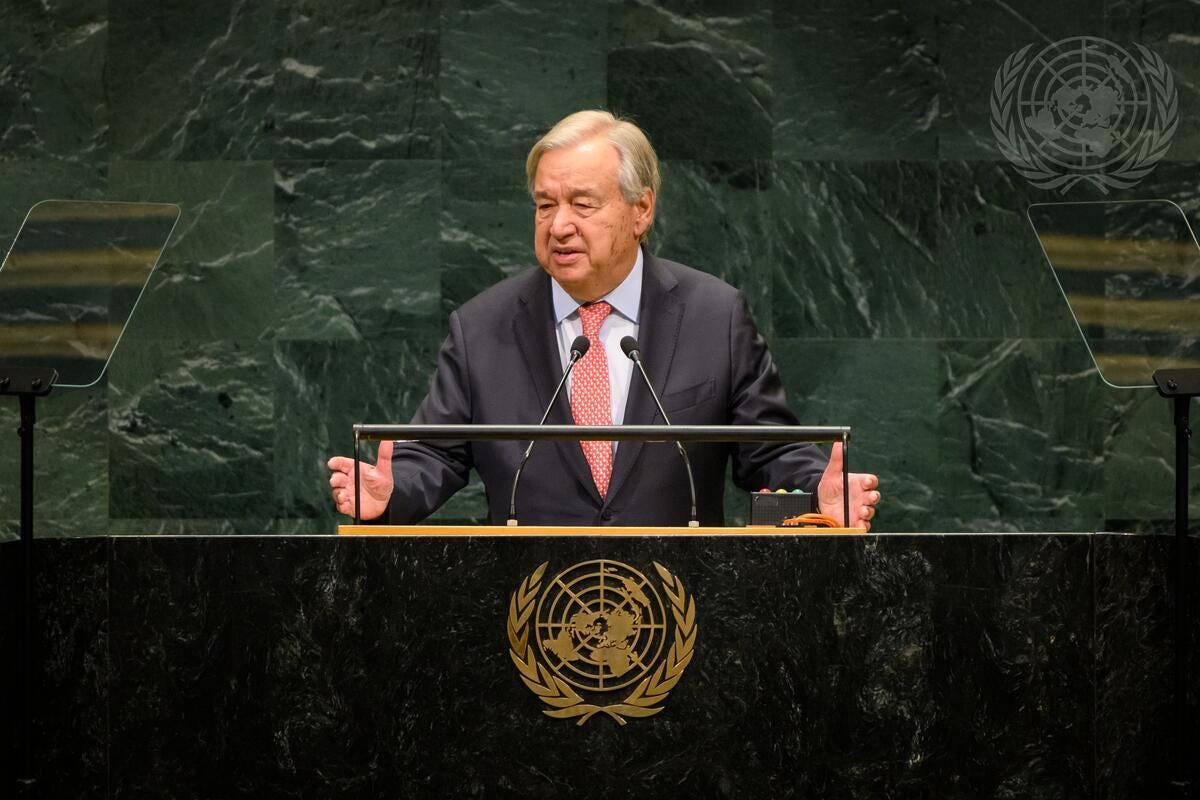
Guterres delivered his final General Debate address as Secretary-General this week. His term ends on 31 December; the next Global Dialogue on AI Governance, scheduled for May 2027, will take place under his successor.
Everyone wants AI governed. No one wants to be governed. For countries with little influence over the major AI suppliers, the UN offers a forum to help shape proposals for safety testing, independent evaluation and incident reporting. But representation is not verification: it supplies neither the access, the expertise nor the authority to check compliance. So the frontier call's backers still owe three answers.
Which powers do existing institutions lack? Who would exercise them? And what obligations would those governments accept for themselves? Until those are answered, treat company promises as claims to be tested, and remember governments already have laws they can enforce.