

At Davos in January, Canada’s prime minister, Mark Carney, described middle powers negotiating separately with a hegemon: “We compete with each other to be the most accommodating.” He called for countries to pool investments and set standards together. On AI, he said Canada was working with other democracies to avoid having to choose between “hegemons and hyperscalers”, the powerful states and companies on which they depend.
This week, European Commission president Ursula von der Leyen called for cooperation on AI with Canada, Britain and others:
“We want to team up on model evaluation, verification, early warning, AI security and much more.”
Ursula von der Leyen, State of the Union address, 16 September 2026
The following day, Carney proposed pooling Canadian and European computing resources in his address to the European Parliament. Canada and Germany are already putting together a Sovereign Technology Alliance. Its co-chairs met on 16 September, with a launch planned in the coming months. Their announcement leaves funding and any common purchasing commitments unspecified.

Mark Carney addressing the European Parliament. © Yves Herman/Reuters.
Countries that depend on foreign AI have reasons to cooperate even when they cannot persuade a leading developer to change its plans. They can share the cost of investigating dangerous capabilities and negotiate for access with stronger safeguards. If they want a developer to accept safety restrictions it opposes, governments would need to explain what they can offer, or withhold, to change its decision.
What middle powers have claimed before
The idea of a middle power dates to 16th-century Italy, where it described states between the great and the small, with enough strength to stand on their own. Canadian and Australian diplomats later gave “middle power” a place in the debate over how the postwar world should be governed.
During the negotiations that created the United Nations, Canada and Australia argued that their contributions to international security should earn them a greater say. In 1945, they pressed for those contributions to count when electing countries to temporary seats on the UN Security Council. That idea made it into Article 23 of the Charter, alongside geographical representation. It did not remove the great powers’ special privileges.
Even as they argued for better representation, Canada and Australia disagreed about enforcing sanctions. A diplomatic cable from the negotiations records Canada’s proposal: Council decisions should initially bind only countries on the Council and those that had agreed to carry them out. Australia wanted all members bound, arguing that uncertainty about enforcement would encourage an aggressor.
An AI purchasing coalition would face a similar disagreement if 1 member insisted on buying a model that the others had rejected. The governments might agree about the risk while disagreeing over whether that assessment should bind them all.
For this discussion, I use “middle powers” to mean countries with the money and institutions to play a part in AI, but which still rely on advanced systems from abroad. That includes Canada, Britain, Japan, South Korea and Singapore, as well as France, Germany and the Netherlands. Some build capable models of their own.
Influence over which decisions?
Research teams could identify risks and develop testing methods that companies adopt. Suppliers of essential chip components could give governments something to bargain with. Access to customers could give companies a reason to meet common requirements.
Public AI bodies in Japan, South Korea, Singapore, Britain and Canada already share testing methods through an international network that also includes the United States. A joint exercise published in January refined tests for information leakage, fraud and cybersecurity threats.
Governments could use those findings when deciding which systems to buy and what to ask of their suppliers. A procurement framework distinguishes a system’s capabilities from the buyer’s influence over its development and use, and from guarantees of continued access. A government willing to accept a less capable model in return for stronger guarantees may struggle to agree on terms with a partner that prioritises performance.
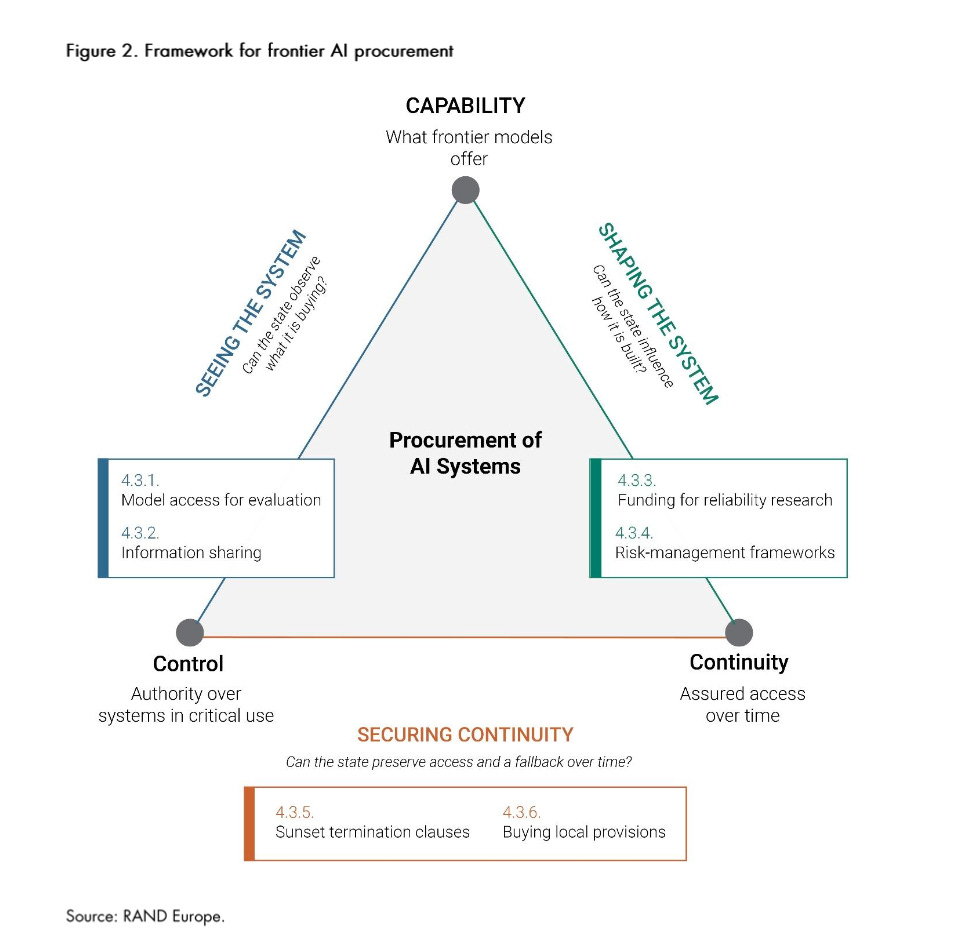
Source: Public procurement and AI governance: Developing a strategic framework for middle powers, RAND Europe, 2026, Figure 2, p. 25.
Governments could keep buying their own systems while asking suppliers for the same independent tests and reports of failures. They could then share the cost of checking whether companies had kept their promises. Public contracts still account for a relatively small part of the leading developers’ business, so a company might prefer to lose those customers than accept their conditions. And a supplier’s promise of continued access may be impossible to keep if its home government orders it to cut a customer off.
A supplier could also offer one government a better deal to persuade it to leave the group. Refusing that offer would cost some members more than others, especially where the alternatives were more expensive or less capable. Even changing companies might leave them using the same cloud infrastructure. Buying together could deepen their dependence on a single supplier if the common requirements were too expensive for smaller competitors to meet.
Countries that host large AI data centres could require cloud providers to report major training runs, or make access to computing power conditional on safety audits. These are among the proposals for compute governance: using the infrastructure needed to train and run models to check and enforce rules. Countries supplying essential chipmaking equipment could also help negotiate such conditions. Developers would have less reason to accept the conditions if they could move the work elsewhere. Monitoring could also expose sensitive data or give cloud providers excessive power over their customers.
A more sceptical view says there is little to achieve by trying to constrain American or Chinese developers. Middle powers would do better to protect their own societies from misuse and economic disruption.
A developer might respond to governments worried about cyberattacks by adding safeguards to the version it sells them, while releasing a less restricted model elsewhere. The buyers would get better protection for their public services and still face attacks enabled by the same system.
Governments can strengthen their cyber defences without waiting for the developer to change course. Sharing the cost of evaluating its models would help them work out what to prepare for, even where they had little influence over the release. Some of those defences may depend on access to advanced AI from abroad. Securing that access could become harder if the countries developing the systems treat them as military assets and restrict their sale.
Europe’s unresolved choices
In his 2024 report, Mario Draghi described governments duplicating each other’s efforts, dividing up funding and pursuing industrial, trade and fiscal policies that did not work well together. He called for more joint funding, simpler rules and faster decisions. His proposal to let willing countries proceed when others could not agree seems especially useful for an AI coalition whose members will have different priorities.
With European Commission support, France and Germany announced a European Frontier AI Initiative in Berlin last November. A founding task force was to establish a nonprofit public-private initiative in the first half of 2026. The ambition was to make it “the best funded non-profit Frontier AI initiative in the world”. In July, France and Germany were still listing work on the organisations that would run it among their next steps.
The EU already has AI rules that apply to foreign models sold in Europe and institutions responsible for enforcing them. The frontier initiative would also make governments funders of the technology. They would have to agree on what to develop in Europe, what to obtain from partners and how much public money to commit.
Those choices were part of a report on Europe and the geopolitics of AGI (not my favourite term) that I co-authored last year. The prospect of faster research and higher output came with a concern about dependence on countries able to use those systems for military advantage or political pressure. We do not know when, or whether, AI will reach that point. Our preparedness plan included decisions about what Europe would build itself and what it could obtain through partnerships, including research and shared computing resources with Canada, Japan and South Korea.
The independent Transformative AI Strategy for Europe puts a rough price on trying to build a European rival to the leading AI companies: around €800 billion during the initial 3 years under a scenario of rapid AI progress, with a range of €445 billion to €1,040 billion. Roughly €529 billion of the central estimate is for AI chips and the data centres to house them. Most of the money would have to come from public funds.
The strategy therefore prioritises reliable access to foreign AI. It proposes a supply-chain alliance involving at least the Netherlands, Germany and France, open to trusted partners outside the EU, to resist attempts to use access to AI for political pressure. The authors give this alliance a defensive purpose; they do not expect it to dictate how foreign companies develop AI. A member with an important chip supplier could contribute to that effort, although using its position might hurt its own company and invite retaliation. Members would have to decide how much of those costs they were willing to share.
The strategy also leaves room for a European developer if governments are prepared to keep funding and supporting it. A domestic project that runs short of money would be of little help if access to foreign systems had been neglected along the way.
A government that has helped to build a developer may be reluctant to restrict its models when safety concerns emerge. In simulated AI crises involving European officials, participants in France, Germany and the Netherlands faced cyberattacks enabled by a fictional, publicly backed model. Restricting it meant acting against the company their government had helped to build, with public money and industrial ambitions tied to its success.
Different ways to work together
Cooperation will take some imagination about which countries work together and how. Minilateralism, a term used in 1992 and popularised in 2009, starts with a smaller group assembled around a particular problem. The idea is to include the countries needed to make a difference, leaving room for others to join.
Schengen began with 5 countries in 1985; 10 years later, 7 had removed controls at their shared borders. In the Ottawa process, Canada, Norway, Austria and South Africa helped organise a wider coalition with campaigners and international organisations. It produced the 1997 treaty banning anti-personnel mines, signed by 122 countries when it opened for signature.
Different interests will lead countries to join some coalitions and sit out others. The AI testing network already includes the United States. Its members might choose different partners to pool computing resources or secure chip supplies. An agreement to monitor large training runs would need the countries hosting the relevant data centres, while conditions on equipment sales would involve the exporting countries.
The AI summit in Geneva in 2027 would be a good place for middle powers to discuss what they want from cooperation on AI and where their interests overlap.