

OpenAI wants to secure funding before Anthropic goes public. Both companies need a ton of money to keep growing, and they’re asking investors who also finance many other businesses.
OpenAI and Anthropic had been expected to deliver two of the most closely watched stock-market listings. But last month, OpenAI ruled out going public this year. It said it needed more time for AI safety work and cooperation with governments and industry.
I’m not convinced safety alone explains the decision. OpenAI is seeking around $30 billion in private funding in a deal that would value the company at $1.25 trillion. That follows a round with $122 billion in committed capital. When it announced its confidential IPO filing, OpenAI said that staying private would make some of its plans easier.
Anthropic took another route. It raised $65 billion in May, including $15 billion previously committed by cloud providers. The deal valued the company at $965 billion. It now aims to go public in mid-November, with a possible valuation of $1.5 trillion. Those plans could still change.
The two fundraising efforts could come just weeks apart. Raising that much money could affect other companies looking for funding, as well as banks, pension funds and, eventually, governments.
What a company gains by going public
In an initial public offering, or IPO, a company offers shares to the public. Selling new shares raises money without taking on a loan. It can also give early investors and employees a chance to sell their stakes.
Public companies must publish their financial results and explain the main risks of the business. Anthropic has warned prospective investors about catastrophic AI risks. It also argues that the transparency required of public companies could improve safety. Nearly a third of the main body of its prospectus is devoted to risks.
Warning investors doesn’t make those risks disappear or shield a company from liability if something goes wrong. If a serious AI incident leads to lawsuits, regulatory action or substantial liabilities, the company and its shareholders still face the financial consequences.
The IPOs that may have to wait
Oura, the company that knows more about our sleep than we do, has postponed its IPO even as it expects revenue to grow 90%. It cited uncertainty in the IPO market. AI companies and everyone else are approaching many of the same investors, and even billionaires have to choose where to put their money.
A pension fund invests people’s retirement savings. If most of that money is already invested and the fund wants shares in a new AI listing, it may need to sell shares it already owns or put less into another company’s offering. That other company may then have to accept a lower price or wait. Some are already timing their listings to avoid competing with Anthropic.
The debt behind the data centers
The companies building and running AI data centers are also borrowing to expand. They’re turning to debt markets that other businesses and governments rely on. Even a profitable company may want to build faster than its business can pay for. By issuing bonds, it gets money from investors and promises to repay it with interest.
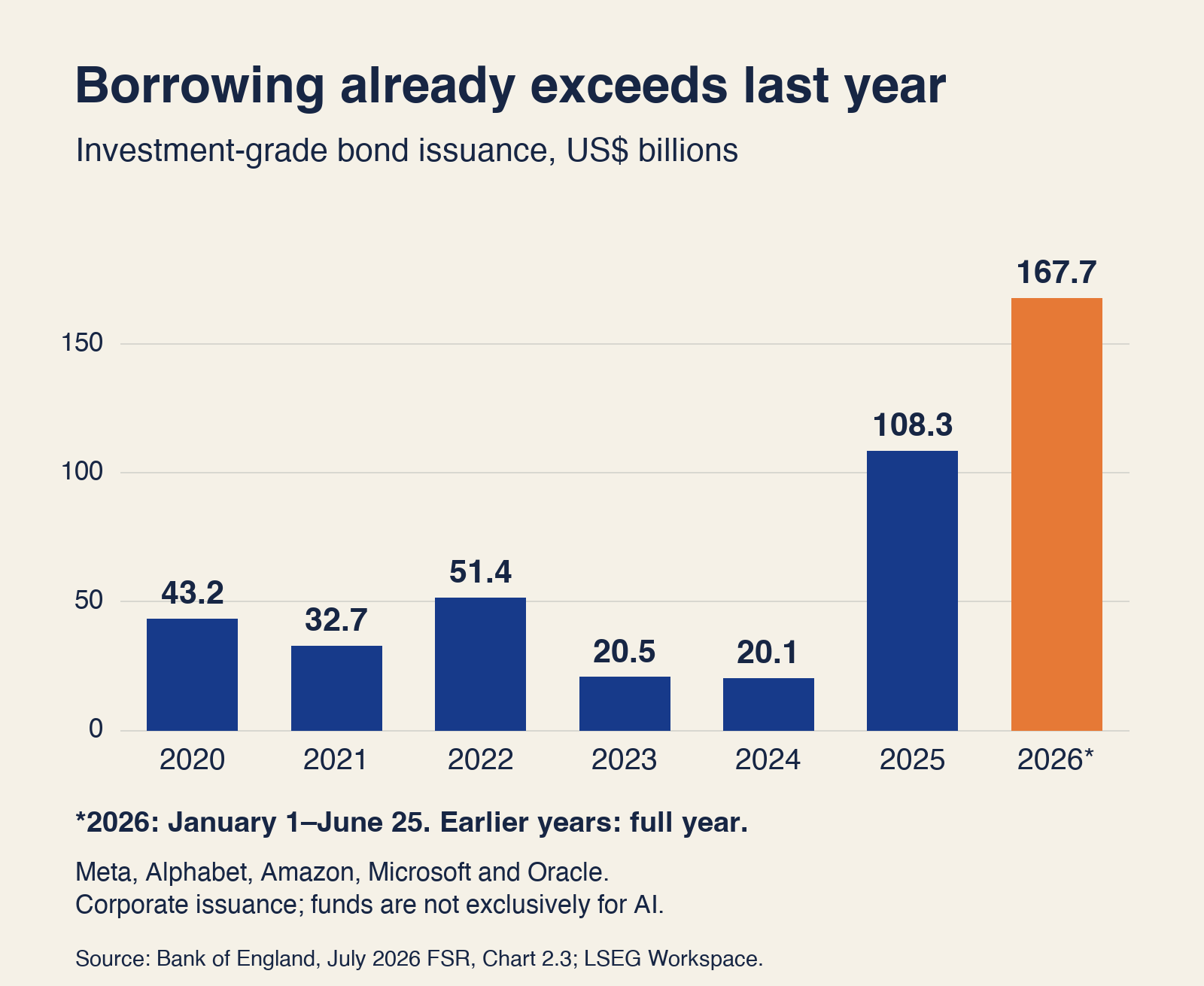
By late June, five major technology companies had raised about $168 billion through bonds, compared with about $108 billion in all of 2025. In one OECD scenario, nine major technology companies could issue around $1.2 trillion in bonds over 2026–2030. That assumes bonds finance 29% of their projected capital spending.
The borrower may instead be the data-center owner, which repays its lenders with rent from a technology company. The technology company may also guarantee payment if the owner cannot pay.
To pay for all this, AI companies need enough revenue. OpenAI and Anthropic are counting on customers paying more for their most capable models. Large Chinese providers could complicate that bet by running AI cheaply at industrial scale.
Beijing’s E-Town development area, for example, offers subsidies to qualifying companies to cover part of the cost of renting computing capacity, making AI cheaper to run.
Fear of falling behind can keep companies building even as competition forces prices down. Lower prices may attract more customers, but the revenue still has to cover years of debt repayments and rent. In the meantime, that construction spending is revenue for chipmakers and other suppliers.
CoreWeave borrows to build computing capacity that it rents to AI companies. This month, the price of some of its bonds fell, pushing their yields to around 15%. A buyer at those lower prices could earn that annual return if CoreWeave makes all its payments. The payments promised on the fixed-rate bonds had not changed.
A growing market for protection against default
Some see echoes of the 2008 financial crisis in AI’s growing debt. A fund can hold its bonds and pay another firm to cover losses if the borrower stops paying. That contract is a credit default swap, or CDS. If several funds buy protection from the same firm, they all depend on its ability to pay.
During the mortgage boom before 2008, banks paid the insurer AIG to take on some of their risk. As mortgage-linked investments lost value, AIG had to put up more cash as security for those commitments. Those demands helped force a government rescue.
According to Morgan Stanley Research, CDS on the debt of seven AI-linked borrowers traded at an average of more than $9 billion a week in September. In July, the figure was below $2 billion.
I really don’t like this chart.
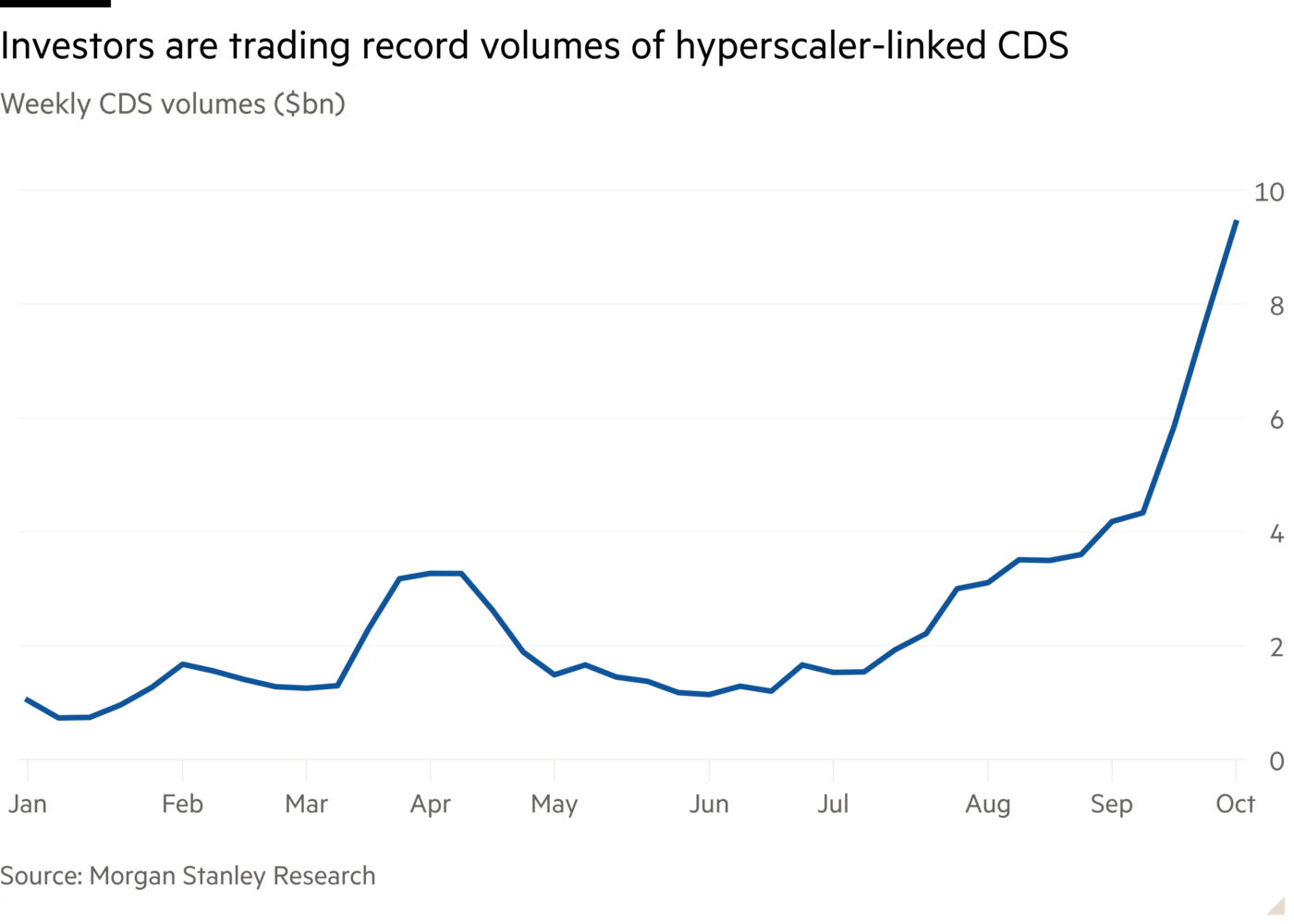
Protection on the same debt can be traded more than once, and new borrowing adds more debt to cover. Buyers include shareholders protecting their stock positions, as well as bondholders worried about a default. Trading volume alone doesn’t tell us how worried investors are, though it is worth watching.
By early September, the cost of that protection had risen for large cloud-computing companies and chipmakers, while staying broadly stable for other S&P 500 companies.
Retirement savings are exposed too
In the US, workers with a 401(k) put part of each paycheck into a retirement account. Employers sometimes contribute too. Those savings often go into funds that pool savers’ contributions to buy shares and bonds. A fund that tracks the S&P 500 holds shares in hundreds of large US companies, with about a third of its money in just seven technology companies.
A pension fund can look diversified while holding several investments that could fall together if AI spending slows. Britain’s Pensions Regulator has flagged that risk and asked trustees to check how investments across the whole fund are connected, including its bonds.
How AI investment could affect public borrowing
Governments seek money in some of the same markets financing AI’s expansion. To improve infrastructure, they may borrow from banks or issue bonds. The risks of their debts differ from those of technology companies, but they share some sources of funding. If AI’s demand for money pushes up interest rates, governments could end up paying more to borrow.
Higher costs can also reach governments through banks, which already lend to data centers and must raise money to keep operating. If that funding becomes more expensive, banks may charge more for loans to build infrastructure.
That pressure can cross borders too. The IMF looks at this risk in Asia. In its scenarios, investment by early AI adopters raises global interest rates. Countries that adopt later can face more expensive borrowing before they benefit from higher productivity.
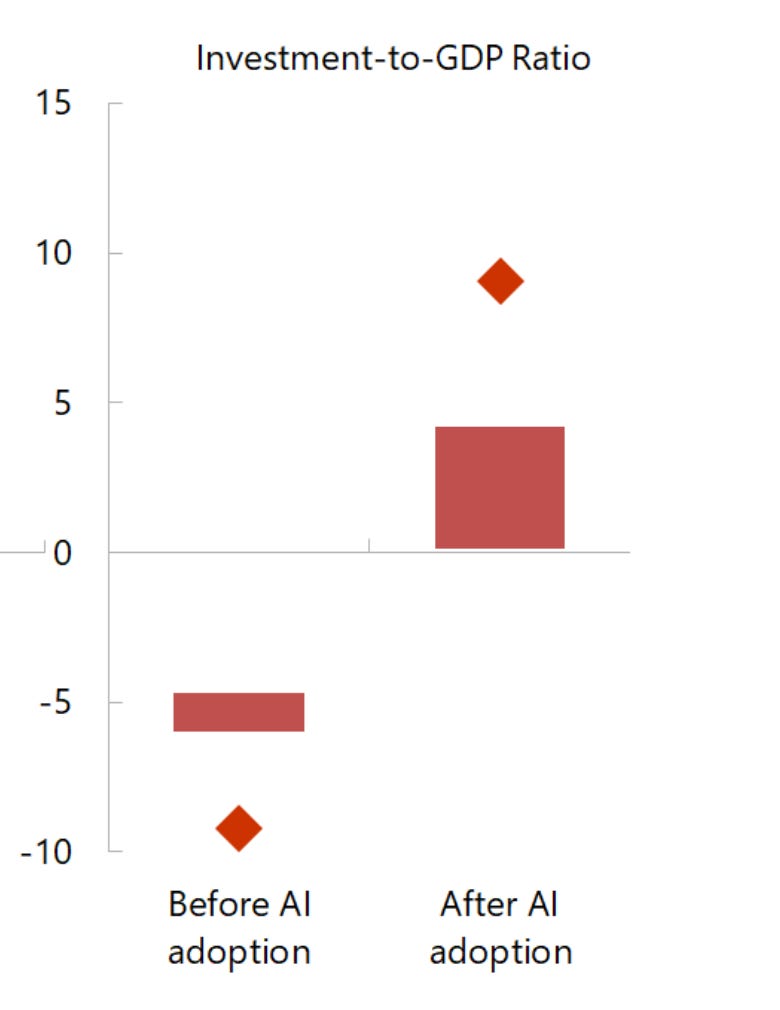
The IMF also warns that government borrowing could become more expensive. So far, there is little evidence of a wider AI-driven funding squeeze.
Even a small rise in rates can affect a public budget. One extra percentage point on $1 billion in new borrowing adds $10 million a year. A government with a fixed budget for debt payments may have to borrow less, scale back a grid extension or delay it. Existing fixed-rate debt keeps its agreed terms. Higher rates affect new borrowing and debt that must be refinanced.
Governments can also turn to development banks. Backing from member countries helps these institutions borrow more cheaply than many governments could on their own, and offer longer repayment periods. They still rely on financial markets, so some of their loans can become more expensive when interest rates rise.
AI could eventually raise productivity and incomes, creating more savings to invest. For now, its expansion is drawing on investors and lenders who also fund other businesses and governments. Competition for that money can affect other borrowers even if the AI investments pay off.
A country can benefit from better technology over time and still need affordable financing for an electricity grid or a public-health system today. If borrowing costs rise before those gains arrive, the government may have to build less or wait longer.